Updated October 2026
EEA Young Economist Award 2025UgandaInfrastructure
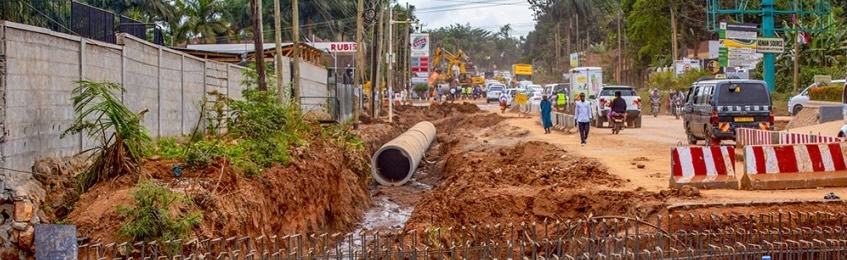
Cities in low-income countries need large investments in road infrastructure. Yet evidence on whether they pay off is limited, in part because the cost of the land they require is hard to measure and routinely ignored. I exploit the timing of the upgrades to estimate the local benefits of 114 km of donor-funded road improvements in Kampala, Uganda (2018–2026), which I embed in a general-equilibrium quantitative spatial model. I collect two new surveys of real-estate brokers and landowners and show that the land-acquisition costs could have amounted to 40% of the project budget under compensation at the legal market rate. As payments for land must be raised from scarce domestic public funds featuring a fiscal wedge, they carry a deadweight loss and paying all owners at market rate would have sharply reduced the otherwise substantial net welfare gains from the improvements. The wedge is highest where roads help most and therefore distorts where it is optimal to build: under market-value compensation the welfare-maximizing program captures only 70% of the first-best gains attainable without paying owners. The misallocation can be mitigated by donor financing of land or alternative compensation like the claim-based rule adopted for most of the studied improvements, under which the probability of compensation varies across the city’s three coexisting land-tenure regimes, recovers 89% of those gains. The broader lesson is one of the second best: requiring full compensation to protect owners need not raise welfare when public funds are scarce, with direct implications for how road investments in fast-growing cities are designed, funded, and evaluated.
PaperVoxDevIGC Policy Brief
with V. Bassi, M. Kahn, N. Lozano Gracia and T. Porzio · Updated April 2026
UgandaAir pollution
We show that the organization of production prevalent in Ugandan cities increases workers’ exposure to urban pollution. Using new granular spatial data on air pollution and manufacturing firms, we document that small firms cluster along the busiest and most polluted roads because road traffic bundles air pollution with customer access. Even within neighborhoods, cleaner areas exist, yet jobs are in the smog. A spatial equilibrium model rationalizes these patterns, with firms capturing sizable profit gains from polluted locations while workers receive limited compensation for the exposure. Our results imply that the welfare costs of urban air pollution in developing-country cities may be substantially larger than city-level averages suggest.
PaperIGC Policy BriefVoxDevYale EGC
with D. Rahut, B. P. Resosudarmo, D. Suryadarma and Y. Sun
R&R (2nd round) · PNASIndonesiaAir pollution
Exposure to fine particulate matter (PM2.5) poses major health risks, especially in rapidly urbanizing cities. As urbanization accelerates, people in low- and middle-income countries spend more time indoors, where pol We present evidence from over 152,000 monitor-hours of indoor PM2.5 measurements across homes in Jakarta, Indonesia, one of the world’s largest and most polluted cities. We find that mean daily indoor and outdoor PM2.5 levels are both dangerously high, eight times above World Health Organization’s (WHO) health-based guidelines. In addition, indoor PM2.5 frequently reach hazardous levels—40 to 100 times the WHO guideline, levels that outdoor monitors do not capture. Unlike in developed settings, most indoor pollution originates from outdoor infiltration. Survey data also reveal large inequalities: lower-income households experience double the mean indoor PM2.5 of higher-income households. Our findings show that indoor air pollution remains both severe and unequally distributed, even in this population where most people have adopted cleaner cooking fuels. Researchers and policymakers should integrate outdoor air quality mapping with demographically representative indoor monitoring to close key data gaps, enabling more accurate exposure estimates and better-targeted environmental health policies.
ADBI Working PaperPosterEast Asia Forum
with B. P. Resosudarmo and Y. Sun · August 2024
Accepted (pre-results) · JDEIndonesiaRCT
Despite the enormous costs of air pollution, willingness-to-pay (WTP) for clean air in polluted developing contexts remains low. We posit one understudied reason is that clean air is an experience good, whose value is revealed after consumption. We test this using a cluster-randomized trial, and seek to document an “experience wedge”, i.e. a difference between anticipated and realized utility of consuming a good. We deploy a novel experience-based intervention, installing air monitors and purifiers, potentially a more salient treatment than traditional information in pamphlets or videos. To explore the mechanisms behind the hypothesized wedge, we implement a purifier-only treatment to distinguish between (1) knowledge about objective pollution exposure and (2) the sensory experience of breathing in clean air. This will be the first experimental evidence demonstrating how experience can shift demand for clean air, with implications for public health policy, environmental awareness campaigns, and using WTP estimates in economic evaluations.
Registered ReportAEA RCT Registry
Accepted at the Journal of Development Economics based on Pre-Results Review; final publication venue TBD.